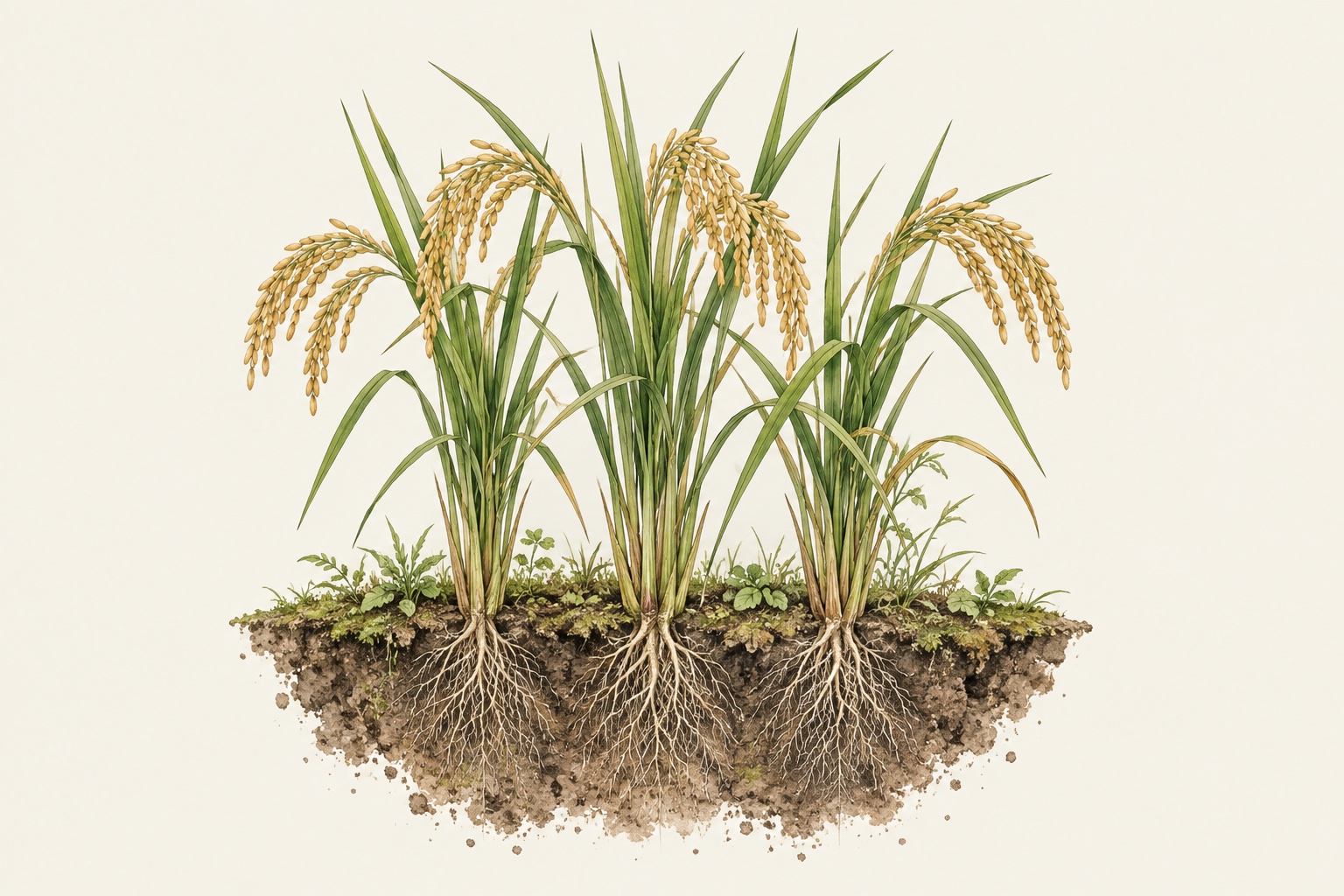
San Pa Tong 1 (สันป่าตอง 1) is a glutinous rice variety. Thailand's Rice Department lists it as photoperiod-insensitive and recommends it for irrigated areas of the upper North and Northeast. These are useful starting points when deciding whether it fits your season. Official variety profile
The reference facts
| Characteristic | Official profile | How to use it |
|---|---|---|
| Grain type | Glutinous | Confirm the grain type your buyer wants. |
| Photoperiod response | Insensitive | Use its variety calendar; do not substitute a jasmine-rice calendar. |
| Harvest age | Approximately 130–135 days | Confirm the starting event before assigning a harvest date. |
| Reported yield | Approximately 630 kg/rai | Treat as a published reference, not this field's forecast. |
| Plant height | Approximately 119 cm | Record your own crop height alongside stage and sampling date. |
Source: Thai Rice Department.
Does 130–135 days mean after transplanting?
The short official profile does not clearly specify the clock's starting event. Do not automatically add 130–135 days to transplanting, or subtract seedling age, without establishing that basis.
Keep three separate records: nursery sowing date, transplanting date and seedling age at transplanting. In a direct-seeded crop, record sowing and establishment observations instead. This gives you enough information to compare your season with a study whose date convention is stated.
Worked record example: seedlings sown 1 August and transplanted 22 August are 21 days old at transplanting. On 21 September the crop is 30 days after transplanting and 51 days after sowing, using elapsed days with the starting date counted as day zero. Those are two descriptions of the same crop, not two different growth rates.
See how crop age, stage and GDD fit together.
What does the yield figure tell me?
The profile does not pair its 630 kg/rai figure with a complete fertilizer treatment, water history, site-season and grain-moisture basis. It cannot tell you how much nitrogen to apply to reach that yield, or what an extra application would earn.
For your own comparison, record harvested area, grain weight and moisture basis, then pair those results with the season's inputs. A yield comparison without those records leaves important differences unresolved.
What should I watch for?
The official profile identifies susceptibility to orange-leaf disease and gall midge. It also describes resistance to blast and bacterial leaf blight; treat those as historical profile statements, not a guarantee against disease in today's field. Profile: strengths and cautions
When problems appear, record the date, affected area and photographs. Ask the local adviser to interpret them alongside current disease information and field history.
Prepare your field record
Before the season, write down the seed source, establishment method, intended water management, previous crop and a realistic yield target with its basis. During the season, record observed stages and applications separately from the plan.
The next useful step is to review fertilizer timing. The variety name helps define context; it does not determine a universal fertilizer recipe.
Editorial preview · 26 September 2026. Sources are linked beside the claims they support. This guide is educational; it does not set a fertilizer dose for your field. Agronomic review is pending.
Explore the rice library