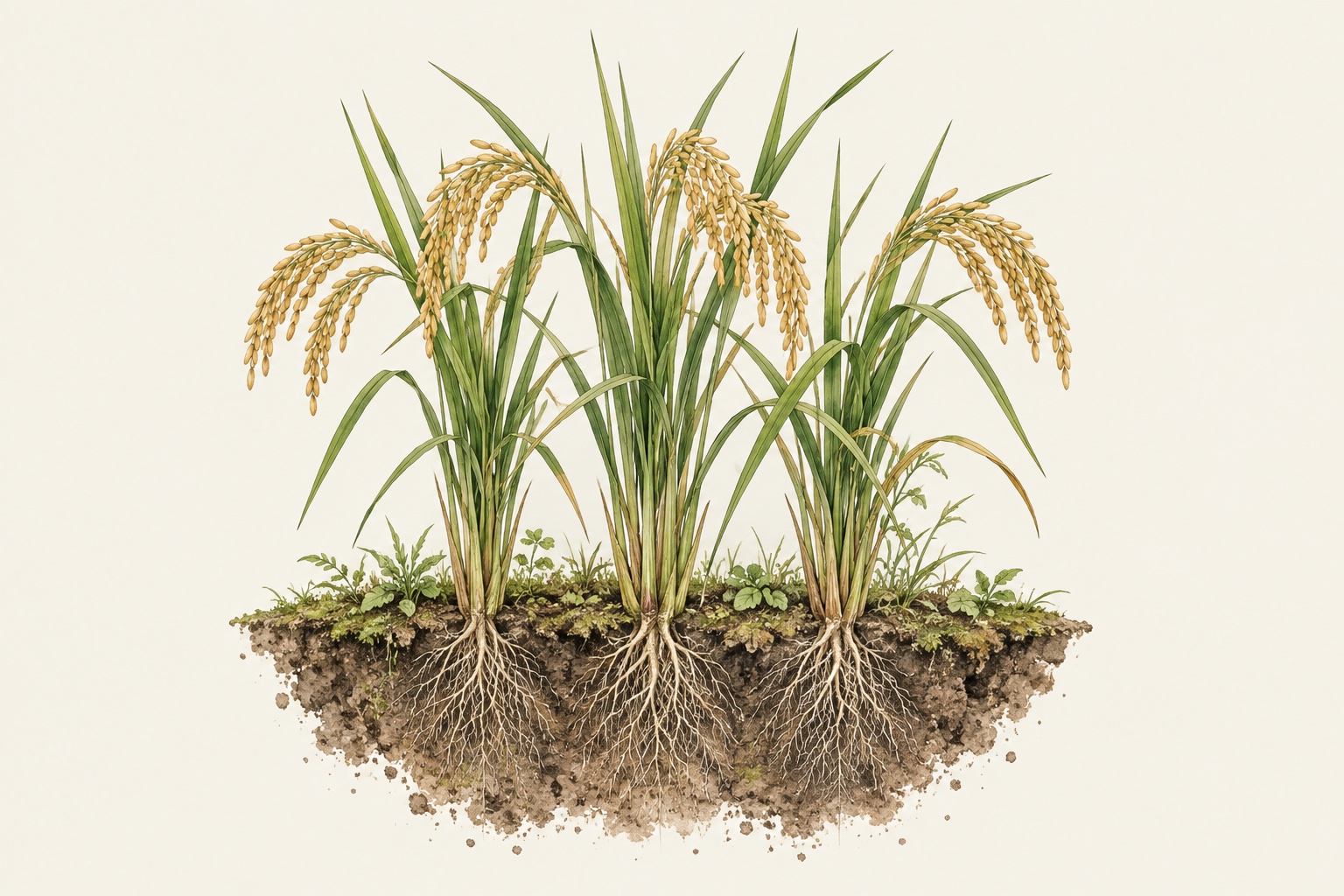
Plan nitrogen around crop demand and what the field has already received. Tillering and panicle initiation are important review points: IRRI identifies both as stages when nitrogen demand can be large. A planned reproductive split should be prepared before its intended window; do not treat booting as another name for panicle initiation. IRRI nitrogen deficiency guidance
The useful question is: what nitrogen does this crop need next, after accounting for previous applications? The date alone does not answer it.
Review the plan in this order
| Check | What to write down | What it changes |
|---|---|---|
| Crop stage | Observed stage, or an explicitly estimated window | Whether this is the intended stage for the split. |
| Previous inputs | Actual date, grade, quantity and treated area | How much nutrient has already gone onto the field. |
| Crop response | Leaf colour, tiller development, uneven areas and symptoms | The evidence for adjusting the existing plan. |
| Water and weather | Field water, irrigation/drainage control and the operation's forecast | Whether the intended placement and timing are practical. |
| Dose basis | Soil-test method, yield target, local guidance and any nutrient credits | How the proposed quantity was established. |
Leaf colour and crop appearance support nitrogen management. They should be read with the crop's input history rather than used as a reason to repeat an application. IRRI nitrogen fact sheet
Fertilizer weight is not nitrogen weight
On a label using the N–P₂O₅–K₂O convention, 15-15-15 means 15% N, 15% P₂O₅ and 15% K₂O by mass. These are nutrient reporting conventions; the second and third numbers are not elemental P and K percentages. University of Minnesota: reading fertilizer labels
Illustrative calculation, not a rice rate recommendation:
A 25 kg application of 15-15-15 contains:
| Nutrient | Calculation | Amount in the application |
|---|---|---|
| N | 25 × 0.15 | 3.75 kg |
| P₂O₅ | 25 × 0.15 | 3.75 kg |
| K₂O | 25 × 0.15 | 3.75 kg |
If that quantity treats 0.5 ha, it supplies 7.5 kg/ha of each reported nutrient. If it treats 0.25 ha, the rate is 15 kg/ha of each. The product weight is identical; the amount per unit area doubles. Always establish whether a record means kilograms per field or kilograms per hectare before comparing plots.
A three-number grade does not specify the split between urea, ammonium and nitrate. Read the product's guaranteed analysis or documented ingredients for that detail. Example guaranteed-analysis structure
How should the next split relate to the crop stage?
During tillering, review the existing N split against crop response. As panicle initiation approaches, reconcile the next planned reproductive application and its quantity. If the protocol says booting, check whether that was the intended timing or a stage-label error before changing the programme.
This is Hypha's practical planning workflow, informed by its sourced rice guidance. It does not establish that a particular field needs an extra dose, or that all varieties should receive the same percentage of seasonal N at each stage.
Granular fertilizer and foliar products are separate operations
Keep separate records for the soil-applied split and any foliar treatment. A planned spray is not proof that it was applied. A tank dilution is not an area dose until treated area and spray-water volume are known.
For a foliar operation, check the formulation's application conditions against the hourly forecast. A daily rainfall total does not tell you whether the required dry interval exists. Avoid adding a product merely because a critical stage is approaching; write down the purpose of the treatment and how its response will be evaluated.
Before changing a treatment in a trial
Preserve the original treatment assignment. Record the proposed change, reason, reviewer and actual application if it goes ahead. That allows later yield comparisons to reflect what the plots actually received.
Start by checking the crop clock, then prepare the application record with the product label, quantity and treated area. Those details make a local fertilizer review much more useful than a generic calendar.
Editorial preview · 26 September 2026. Sources are linked beside the claims they support. This guide is educational; it does not set a fertilizer dose for your field. Agronomic review is pending.
Explore the rice library