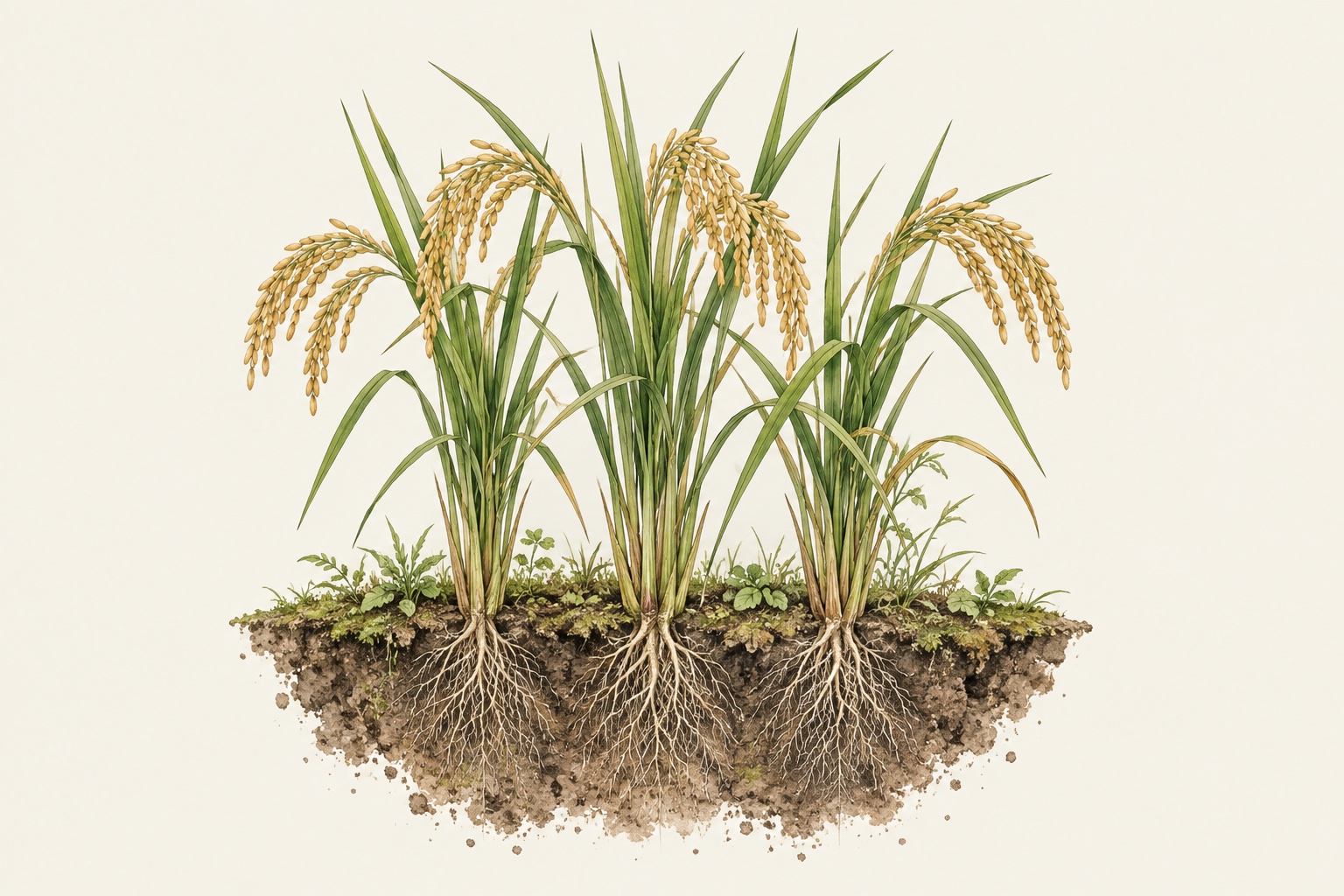
A planting date tells you how old the crop is. A field observation tells you what it is doing. Use both: plan visits and inputs with a variety calendar, then record the stage you find when you inspect the crop.
IRRI recommends building a crop calendar around the selected variety and the operations needed through the season. IRRI crop calendar
The stages worth recording
| Stage | What the stage describes | Useful field record |
|---|---|---|
| Establishment | The crop is establishing after seeding or transplanting. | Sowing/transplant date, seedling age and gaps in establishment. |
| Tillering | Side shoots develop. | Comparable tiller counts and leaf-colour readings. |
| Panicle initiation | The panicle begins developing inside the stem. | A stage check by someone trained to inspect the developing panicle. |
| Booting | The developing panicle is enclosed within the leaf sheath. | Date observed; keep separate from panicle initiation. |
| Heading and flowering | Panicles emerge and flowering takes place. | Record which event you observed and the proportion of the field affected. |
| Grain filling and maturity | Grains develop and progress toward maturity. | Grain condition, observed maturity and eventual harvest date. |
This is a simplified sequence for field records. It is not a fixed number of days between stages. IRRI's teaching material distinguishes vegetative, reproductive and ripening phases. IRRI stage framework
DAT and DAS: the same crop, two clocks
- DAS: elapsed days after sowing.
- DAT: elapsed days after transplanting.
For example, a nursery sown on 1 August and transplanted on 22 August is 21 days old at transplanting. On 21 September it is 51 DAS and 30 DAT. Here day zero is the sowing or transplanting date; field protocols should state their convention.
If a study reports 50 DAS, do not read that as 50 DAT. If the nursery date is unknown, record seedling age as an estimate rather than invent an exact sowing date.
What GDD adds
Growing degree days summarize temperature exposure using a stated calculation. Hypha currently uses the following daily calculation for its rice temperature clock:
daily GDD = max(0, min((daily maximum + daily minimum) / 2, 30) − 10)
The base is 10 °C and the daily-mean cap is 30 °C. These are Hypha's configured calculation settings, not a claim that every rice model uses the same method.
Worked example: a day with a 32 °C maximum and 22 °C minimum contributes 17 °C·day: the mean is 27 °C, and 27 − 10 = 17. An illustrative sequence of ten identical days would contribute 170 °C·day.
The sum must show its starting date and missing temperature days. A field clock starting at transplanting does not include the nursery's temperature exposure. Hypha keeps those boundaries explicit rather than filling missing days with zero.
Can I turn GDD into a harvest percentage?
Only compare an accumulated total with a target using a compatible temperature method, starting event and variety model. A base-10 daily-mean total cannot simply be divided by a coefficient from a different crop model and called harvest progress.
Similarly, converting a published duration into GDD with an assumed temperature creates a planning scenario. It does not establish a measured variety threshold. For a photoperiod-sensitive variety, the model must also account for daylength; a thermal sum on its own is not a complete flowering model.
What to do on your next visit
Record the date, stage observed, where you checked and whether the field is uniform. A stage observation may move the next review earlier or later than the calendar. Keep that observation alongside the estimate so your adviser can see why a plan changed.
Use the stage record to review the next nitrogen split.
Editorial preview · 26 September 2026. Sources are linked beside the claims they support. This guide is educational; it does not set a fertilizer dose for your field. Agronomic review is pending.
Explore the rice library